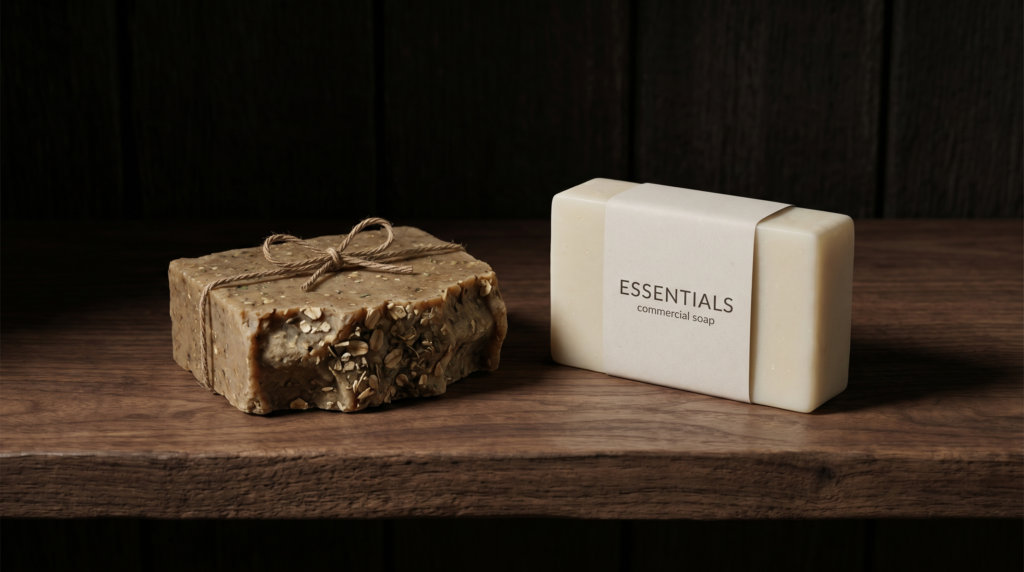
Pine Forge Soap Co. makes and sells handmade tallow soap, so we have an obvious stake in this comparison. We’ve tried to keep it to differences we can actually stand behind, and to flag where a common claim goes further than the evidence does.
Most men pick soap the way they pick gas station coffee — grab whatever’s closest and don’t think about it again. For a lot of people that’s genuinely fine. But if you’ve wondered what actually differs between a drugstore bar and a handmade cold-process one, there are real differences worth understanding — and a few widely repeated claims that don’t hold up.
What Mass-Market Soap Is Usually Made Of
Read the label on most drugstore bars and you’ll typically find a saponified base (often sodium tallowate or sodium palmate), frequently a synthetic surfactant such as sodium lauryl sulfate or sodium laureth sulfate, synthetic fragrance, a chelating agent like EDTA, titanium dioxide for opacity, and stabilizers for shelf life.
None of that is inherently harmful, and plenty of people use these bars for decades without a problem. The honest framing is about what the formulation optimizes for: manufacturing cost, shelf stability, consistency at scale, and big lather. Skin feel after the wash is one input among several, not the priority.
It’s also worth saying that “commercial soap” isn’t one thing. Some mass-market bars are genuinely mild and some are marketed specifically for sensitive skin. Blanket statements about every bar on the shelf aren’t accurate, and we’re not going to make them.
The Glycerin Difference
This one is real, and it’s probably the clearest structural difference between the two categories.
Saponification naturally produces glycerin. Glycerin is a humectant, meaning it attracts water. In cold-process soap made in small batches, that glycerin stays in the bar because there’s no separation step. In large-scale industrial soapmaking, the glycerin is commonly separated out during processing — it’s a valuable ingredient in its own right and gets sold into other products.
Two caveats we’d rather state than gloss over. First, this isn’t universal: not every commercially produced bar has had glycerin removed, and some add glycerin back. Second, glycerin in a wash-off product rinses down the drain along with the soap, so retained glycerin is a milder-feeling bar rather than a leave-on treatment. It’s a real difference in how the bar feels, not a substitute for moisturizer.
What Cold-Process Tallow Soap Is Made Of
A quality tallow bar typically combines:
- Beef tallow — the primary fat. High in saturated and monounsaturated fats, which makes a hard, mild, long-lasting bar with a conditioning feel.
- Coconut oil — contributes hardness and abundant lather. Used heavily it can be drying, so it’s a balance rather than a maximize.
- Olive oil — high in oleic acid; produces a notably mild, gentle bar.
- Castor oil — boosts and stabilizes lather, adds a creamy quality.
- Mango or shea butter — adds slip and a softer feel to the finished bar.
One thing worth clearing up because it comes up constantly: the lye (sodium hydroxide) is fully consumed during saponification. There is no lye left in a properly made, properly cured finished bar. What you’re left with is soap, glycerin, and a small amount of unsaponified oil — the superfat.
Where the Tallow Claims Go Too Far
You’ll often read that tallow is “biologically designed” for human skin, or that its fatty acid profile matches human sebum. We make tallow soap and we still think that’s overstated.
Tallow is largely oleic, palmitic and stearic acid, and those fatty acids do appear in human sebum. But human sebum also contains squalene, wax esters and free fatty acids in proportions tallow doesn’t share — the two are similar in parts, not equivalent. And once a fat has been saponified it is chemically soap, not the original fat. The defensible version is simpler: tallow makes an excellent bar — hard, mild, stable, good lather, long-lasting. That’s why we use it. It doesn’t need a biology claim on top.
The same goes for vitamins. Tallow contains small amounts of fat-soluble vitamins, but we’ve seen no good evidence that meaningful amounts survive saponification and do anything useful in a product you rinse off in a minute.
The Lather Myth
Switching from a mass-market bar to a cold-process one, the first thing most people notice is that the lather is different — denser and creamier rather than big and foamy.
That difference doesn’t mean it’s cleaning less. Foam volume and cleaning power are not the same thing: the surfactants do the cleaning, and the visible foam is largely cosmetic. High-foaming bars often get that volume from added foaming agents. A cold-process bar lathers from its own saponified oils, so the lather is a byproduct of the soap rather than an additive.
Longevity: Which Bar Lasts Longer
In our own experience making and using these, a well-cured tallow bar outlasts a typical drugstore bar, and there are sound reasons why. High saturated fat content makes the bar physically hard, so it holds up under running water instead of going soft. And a properly cured bar has lost a good deal of its water, leaving a denser bar that dissolves more slowly.
How that works out per wash depends on your shower habits, your water, and whether you leave the bar sitting in a puddle — a soap dish that drains makes more difference than most people expect.
Skin Feel: The Most Noticeable Difference
This is where people notice the change most immediately. After a strongly stripping bar, skin can feel tight — the “squeaky clean” feeling. That’s a sign the bar removed more surface oil than your skin would prefer. For most people that’s a comfort issue that resolves with moisturizer, not damage.
You’ll sometimes see the claim that stripping your skin makes it produce more oil in compensation. We’ve left that out, because the evidence for it is not settled, and we’d rather under-claim than repeat something we can’t back.
What we’ll say is narrower: a higher-superfat, sulfate-free bar tends to leave skin feeling less tight after washing. Whether that matters to you depends on whether tight skin after a shower is something you currently notice.
If your skin is genuinely dry, irritated or persistently uncomfortable, that’s a question for a doctor or dermatologist rather than a soap purchase. The American Academy of Dermatology’s dry skin guidance puts shorter, cooler showers and moisturizing damp skin ahead of any particular cleanser — advice worth taking regardless of which bar you buy.
Side by Side
| Typical mass-market bar | Handmade tallow bar | |
|---|---|---|
| Optimized for | Cost, shelf life, foam, scale consistency | Skin feel and bar quality in small batches |
| Glycerin | Commonly separated out in industrial processing | Retained from saponification |
| Surfactants | Often includes SLS/SLES | Saponified oils only (no SLS/SLES at Pine Forge) |
| Superfat | Rarely disclosed | Built in deliberately |
| Lather | High volume, airy | Denser, creamier |
| Cure time | Not applicable to industrial processes | Cured before sale |
| Price per bar | Lower | Higher upfront; tends to last longer |
The Bottom Line
Mass-market soap is built to be made at enormous scale, cheaply and consistently. Cold-process tallow soap is built in small batches where skin feel is the main thing being optimized. Both get you clean. The difference is in the finish, the lather, how long the bar lasts, and what you can find out about what’s in it.
Every bar at Pine Forge Soap Co. is handmade in small batches, cured before it’s sold, tallow-forward, with extra oil deliberately left in (the superfat) and no SLS or SLES. We make them ourselves in Daytona Beach, which is why we can tell you exactly what goes into every bar.
If you want to try one, browse the soap range — eight scents on the same tallow base — or the full lineup. If you’d rather start small, the three-bar Core bundle is the usual entry point. If dry skin is your specific concern, we go into more detail in choosing soap for dry skin.
Frequently Asked Questions
Is there lye in the finished soap?
No. Sodium hydroxide is the reagent that turns oils into soap, and it is fully consumed during saponification. A properly formulated and cured bar contains no free lye. Every real soap — including the bar in your shower right now — was made with it.
Does commercial soap really remove the glycerin?
Often, but not always. Separating glycerin during processing is standard in large-scale production because glycerin has value as a separate ingredient. It is not universal, and some manufacturers add glycerin back. If it matters to you, cold-process and handmade bars are the reliable way to know it’s still in there.
Is tallow soap better for sensitive skin?
It can be milder, particularly if you’re reacting to sulfates or undisclosed fragrance — but “sensitive skin” covers a lot of different causes and we can’t tell you ours will suit you. We haven’t done clinical testing and we don’t have dermatologist endorsement. If you have a diagnosed skin condition, ask your dermatologist before changing your routine, and patch test anything new.
Why does a handmade bar cost more?
Small batches, better fats, a cure period during which the soap is sitting on a shelf rather than being sold, and no economies of scale. Whether that’s worth it to you is a fair question — the bar does tend to last longer, which narrows the gap per wash, but it won’t close it entirely.