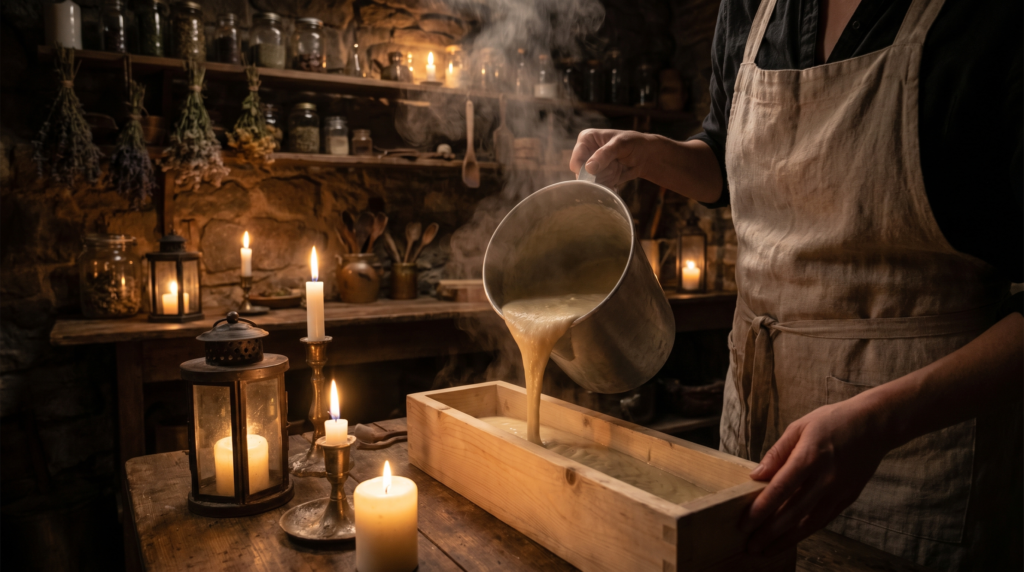
Cold process soap is the oldest and most natural method of making soap that still exists. Before the industrial era changed how personal care products were manufactured, this is how soap was made. The name refers to the fact that no external heat is applied during the saponification process — the chemical reaction between oils and lye generates its own heat, and the soap is left to cure at room temperature. What comes out the other side is a bar that’s fundamentally different from anything made on a production line.
The Chemistry Behind It
Soap is the product of a reaction called saponification. When a strong alkali — sodium hydroxide (lye) for bar soap — is combined with fats or oils, it breaks the triglycerides apart and converts them into soap molecules and glycerin. The soap molecules are what clean your skin. The glycerin is what conditions it.
In cold process soap-making, the oils are melted and brought to the right temperature. The lye is dissolved in water or milk and also brought to temperature. The two are combined and mixed until they reach “trace” — a point where the mixture thickens to a consistency similar to pudding. At trace, fragrance, colorants, and any additional ingredients are added. The soap is then poured into molds and left to saponify on its own.
The lye is completely consumed in this reaction. Finished cold process soap contains no free lye — the chemistry doesn’t work that way. What remains is soap, glycerin, and any unsaponified oils left intentionally by the maker (called superfat).
What Superfat Means and Why It Matters
Superfat is the percentage of oils in a cold process recipe that are intentionally left unsaponified. A 5% superfat means 5% of the oils weren’t converted to soap — they remain free in the bar as conditioning agents.
This is one of the most important variables in soap-making. Zero superfat means every oil was converted — technically efficient, but harsh on skin. A very high superfat (above 8–10%) means better conditioning but a bar that can go rancid faster and may feel greasy. Five percent is the standard for a reason — it’s the balance point between conditioning and stability.
At Pine Forge, every bar is made at 5% superfat. Not because it’s easiest, but because it’s right.
The Cure
After the soap is poured into molds, it needs to cure — typically for four to six weeks at minimum. During cure, a few things happen. The saponification process completes fully. Excess water evaporates from the bar, making it harder and longer-lasting. The fatty acids in the soap continue to rearrange at a molecular level, which makes the bar milder and gentler on skin than a freshly made bar.
A cold process bar that hasn’t cured long enough is softer, dissolves faster, and can sometimes feel more alkaline on skin. This is why commercially manufactured soap — which goes through an accelerated hot process and is often sold almost immediately — can feel harsher than properly cured handmade soap even if the ingredients look similar on paper.
Cold Process vs. Hot Process vs. Commercial
Hot process soap uses external heat (a slow cooker or oven) to accelerate the saponification reaction, so the soap can be used almost immediately after it’s made. The tradeoff is texture — hot process soap tends to have a rougher, more rustic appearance, and fragrances can be harder to incorporate without fading or morphing. Cold process allows for more creative control over color, design, and scent.
Commercial soap production uses a continuous process that runs at high heat, removes the glycerin for resale, and can compress the entire manufacturing timeline to hours rather than weeks. The result is consistent and cheap. It is not, by any reasonable definition, soap in the traditional sense.
Why It’s Worth the Extra Cost
Cold process soap costs more to make and more to buy. The ingredients cost more. The time investment is longer. Yield per batch is lower. And a significant percentage of every batch goes toward the cure period, meaning a maker has capital tied up in bars sitting on a shelf for six weeks before a single bar can ship.
What you get for that cost is a bar made with real oils, retaining its natural glycerin, cured to its full potential, and formulated by someone who actually understands what each ingredient does. That’s a different product than a $1.99 bar from a factory. Your skin knows the difference within a week.
Every bar at Pine Forge Soap Co. is cold process, cured for a minimum of four weeks, and made in small batches. No shortcuts. See what’s in stock.
Frequently Asked Questions
Is lye safe in cold process soap?
Yes. Lye (sodium hydroxide) is a required ingredient to make real soap — without it, saponification cannot occur. In finished cold-process soap, all of the lye has been consumed by the chemical reaction. There is no free lye in a properly made and fully cured bar. You cannot have real soap without using lye at some point in the process.
How long does cold process soap need to cure?
A minimum of 4 weeks, with 6 weeks being ideal. During cure, excess water evaporates, the bar hardens and becomes milder, and the saponification process fully completes. A bar that hasn’t cured long enough will be soft, dissolve quickly, and may feel harsher on skin than a fully cured bar.
What is superfat in cold process soap?
Superfat is the percentage of oils intentionally left unsaponified in the finished bar. A 5% superfat means 5% of the oils were not converted to soap — they remain as free conditioning agents. This is the standard for a reason: high enough to condition, low enough that the bar won’t go rancid or feel greasy.