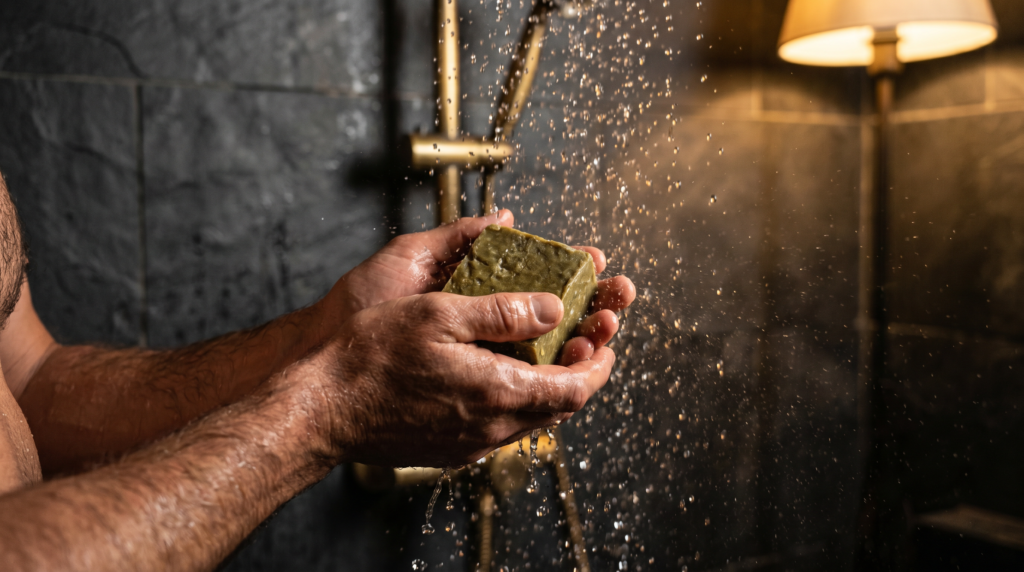
A note on who’s writing this: Pine Forge Soap Co. makes and sells the tallow soap discussed below. We’ve tried to keep the general guidance useful whether or not you buy from us, and to be clear about which statements are our own experience rather than established fact.
Dry skin in men usually comes down to a mix of things you can’t change — genetics, age, climate, the weather where you work — and things you can, like how long you shower and what you wash with. Soap is the easiest variable to control, and most bars marketed to men are formulated for bold scent and big lather rather than for skin that’s already dry. Here’s how to tell the difference, and where soap genuinely helps versus where it isn’t the right tool at all.
First: What Soap Can and Can’t Do
Soap is a cleanser. A well-formulated bar can clean without leaving your skin feeling stripped, and that’s a real and worthwhile difference. What soap cannot do is treat a skin condition.
If your dryness comes with persistent redness, cracking, bleeding, scaling, intense itching, or it doesn’t improve when you change your routine, that’s worth a conversation with a doctor or dermatologist rather than a different bar of soap. Eczema, psoriasis, and contact dermatitis all look like “dry skin” from the outside and need actual treatment. Nothing on this page is medical advice, and changing soap is not a substitute for care.
What Dermatologists Actually Recommend First
Before getting into soap formulation, it’s worth knowing that the highest-impact changes usually aren’t about which bar you buy. The American Academy of Dermatology’s guidance for relieving dry skin recommends:
- Limiting baths and showers to five to ten minutes, using warm rather than hot water
- Washing with a gentle cleanser, and choosing fragrance-free products if your skin is sensitive — they specifically note that deodorant soaps are often too harsh for dry skin
- Patting skin dry rather than rubbing
- Applying moisturizer while skin is still damp, several times a day, with ointments and creams being more effective than lotions
That last point matters, and we’ll come back to it: moisturizer does a job that soap does not.
Why Some Bars Leave Skin Feeling Tight
Many mass-market body washes, and some bars, use synthetic surfactants — sodium lauryl sulfate (SLS) and sodium laureth sulfate (SLES) are common examples — because they’re inexpensive and produce a lot of foam. They’re effective at removing oil, and they aren’t especially selective about which oil they remove.
SLS in particular is well enough established as a skin irritant that dermatology researchers use it as a model irritant when testing how skin reacts (see this British Journal of Dermatology commentary). That doesn’t make every product containing it harmful to every person — concentration, contact time and individual sensitivity all matter, and a bar you rinse off in thirty seconds is not a patch test. But if your skin is already dry and reactive, a sulfate-led bar is a reasonable thing to try eliminating.
The tight, squeaky feeling after a shower is a sign the bar removed more oil than your skin would prefer. For many people that’s uncomfortable rather than harmful, and it resolves with moisturizer.
Selection Criteria: What to Actually Look For
If you’re reading labels, these are the variables that genuinely differ between bars:
| What to look for | Why it matters | How to spot it |
|---|---|---|
| Superfat | Unsaponified oils left free in the finished bar, so it cleans with a little fat still in play rather than stripping to bare skin | Rarely on the label. Some handmade makers mention it; mass-market brands generally don’t. |
| Retained glycerin | Glycerin is a humectant — it attracts water. Soap made in small batches without a separation step keeps the glycerin produced during saponification. | Handmade bars generally retain it. Some large-scale processes separate it out, and some brands add glycerin back — check the ingredient list. |
| Conditioning base oils | Bars built mainly on olive oil, shea butter, mango butter or tallow generally feel milder and more conditioning than coconut-led formulas | Read the order of the ingredient list. If coconut oil leads, expect big lather and a drier finish. |
| No synthetic sulfates | Removes the most common stripping agent if your skin is reactive | Check for sodium lauryl/laureth sulfate in the ingredients. |
| Fragrance disclosure | “Fragrance” or “parfum” can be an undisclosed blend; undisclosed fragrance is a common irritant for sensitive skin | If your skin is sensitive or reactive, the AAD recommends products labeled “fragrance-free” — and notes that “unscented” products can still contain chemicals that mask odors. |
On the label, conditioning oils usually appear as sodium tallowate, sodium olivate, sodium castorate, butyrospermum parkii (shea butter) and mangifera indica seed butter (mango butter).
Quick Comparison: Which Kind of Cleanser Fits You
| Option | Best for | Trade-off |
|---|---|---|
| Fragrance-free gentle cleanser | Very dry or sensitive skin, or a diagnosed skin condition | A plainer experience — but it’s the AAD’s default recommendation for dry skin |
| Handmade tallow bar (like ours) | Men whose skin tolerates fragrance and who want a bar that doesn’t leave skin feeling stripped | Scented, and not clinically tested |
| Deodorant bar soap | Odor control | The AAD flags deodorant soaps as often too harsh for dry skin |
Where Tallow Fits
Beef tallow is mostly oleic, palmitic and stearic acid. Those same fatty acids appear in human sebum, which is where you’ll often see the claim that tallow “matches” human skin oil. That comparison is loose rather than exact: human sebum also contains squalene and wax esters that tallow doesn’t, and once fat is saponified into soap it is chemically no longer the original fat. We think the honest version is narrower — tallow makes a hard, mild, stable bar with a conditioning feel, and that’s why we build on it.
You’ll also see claims that tallow delivers vitamins A, D, E and K to your skin. Tallow does contain small amounts of fat-soluble vitamins, but we have not seen evidence that meaningful quantities survive saponification and reach your skin in a usable way through a wash-off product, so we don’t make that claim about our bars.
Practical Things That Help With Dry Skin
- Shorten the shower and drop the temperature. Hot water and long exposure do more drying than most soap does.
- Moisturize while damp. This is the single most repeated piece of dermatological advice for dry skin, and it works better than any soap swap.
- Change one thing at a time. If you swap soap, moisturizer and detergent in the same week, you won’t know what helped.
- Watch your laundry detergent and hot-water hand washing. Hands and forearms often take the worst of it.
- Humidity matters. Indoor heating in winter and air conditioning in a Florida summer both pull moisture out of skin.
The Pine Forge Formula
Every Pine Forge bar is handmade in small batches, cured before it’s sold, and built on a tallow-forward formula with extra oil deliberately left in (the superfat) and no SLS or SLES. The supporting oils vary by scent line; the intent is consistent — clean without that stripped feeling, condition without greasiness, and lather from saponified oils rather than added foaming agents.
One honest limitation: every Pine Forge bar is scented. The American Academy of Dermatology recommends fragrance-free products for dry, sensitive skin. If fragrance bothers your skin, or a dermatologist has told you to go fragrance-free, our bars aren’t the right pick — a fragrance-free gentle cleanser is.
We’re a small operation and we make these ourselves, so we can tell you exactly what’s in them. What we can’t tell you is how your skin will respond — we haven’t run clinical testing, and we don’t have dermatologist endorsement. Skin varies, and anyone promising you a guaranteed result from a bar of soap is overselling.
If you want to try one: browse the full range of natural soap for men — eight scents, all on the same tallow base — or see the complete lineup. If you’d rather not commit to a full-size bar collection, the three-bar Core bundle is the usual starting point.
Frequently Asked Questions
What ingredients should men with dry skin avoid in soap?
If your skin is dry or reactive, the common candidates to eliminate are sodium lauryl sulfate (SLS), sodium laureth sulfate (SLES) and undisclosed “fragrance” or “parfum.” The AAD specifically flags deodorant soaps as often too harsh for dry skin. This is about finding what your skin tolerates rather than a list of universally harmful ingredients — plenty of people use all of the above without trouble.
Can tallow soap replace moisturizer for dry skin?
No — we wouldn’t make that claim. A gentler bar can reduce how stripped your skin feels after washing, and some people find they reach for lotion less often as a result. But moisturizer does a different job than soap: it adds and seals in moisture, and soap rinses off. Dermatological guidance is consistent on applying moisturizer to damp skin after washing, and switching soap doesn’t replace that step. If your skin is dry, use both.
Is tallow soap good for the face?
Plenty of people use a mild bar on their face and get on with it fine, and a superfatted tallow bar generally feels milder than a sulfate-based one. But facial skin is thinner and often more reactive than the skin on your body, and we can’t tell you it will suit everyone — if you’re acne-prone or have sensitive facial skin, a dedicated facial cleanser may suit you better. The AAD’s face washing guidance recommends a gentle, non-abrasive, alcohol-free cleanser and doesn’t endorse any particular bar. If you want to try ours on your face, patch test it first and stop if it doesn’t agree with you.
How long before I notice a difference?
We don’t have data on this and won’t invent a number. If a soap is going to suit you better, you’d generally expect to notice how your skin feels after washing fairly quickly. If nothing improves after a few weeks of consistent use — and you’ve also shortened showers and started moisturizing — then soap probably wasn’t the limiting factor, and it’s worth asking a professional.
Got a beard?
The skin under a beard gets overlooked more than anywhere else. If you’re growing one, soap is only part of it — beard oil reaches the skin underneath, and balm adds hold on top. We’ve broken down the difference in beard oil vs beard balm, or browse the Beard Care collection.